The Trucker's Crazy Idea That Made Your Walmart Shopping Possible
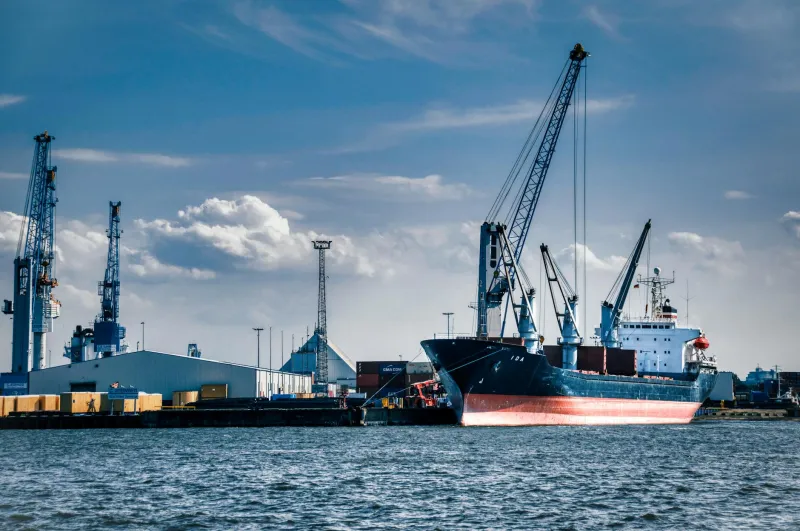
The Box That Built Modern Life
Look around your house right now. Your coffee from Colombia, your shirt from Vietnam, your phone assembled in China, your furniture from Sweden. None of it would be sitting in your home at a price you could afford without a simple metal box that shipping experts once dismissed as the dumbest idea they'd ever heard.
Malcolm McLean wasn't trying to revolutionize global commerce when he got frustrated waiting in line at a New Jersey port in 1937. He was just a trucker who thought there had to be a better way to move stuff from trucks onto ships without spending all day watching dock workers unload his cargo piece by piece.
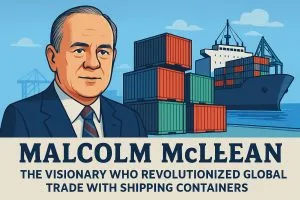 Photo: Malcolm McLean, via www.cbmcalculator.com
His solution was so obvious that everyone assumed it couldn't work: why not just put the entire truck trailer on the ship?
The Expensive Way Things Used to Move
Before McLean's containers, moving goods across oceans was a nightmare of inefficiency that kept imported products expensive for ordinary Americans. Ships arrived at ports where armies of longshoremen spent days unloading cargo piece by piece: individual boxes, barrels, crates, and sacks that had to be manually carried from ship to dock.
A typical cargo ship might spend more time in port being loaded and unloaded than it spent actually sailing. Theft was rampant—dock workers called it "honest graft" to walk away with whatever they could carry. Damage was routine. Delays were constant.
The result was that shipping costs added enormous markups to anything that crossed an ocean. Imported goods were luxuries that most Americans couldn't afford, not because they were expensive to make, but because they were expensive to move.
The Idea That Almost Didn't Happen
McLean spent twenty years running his trucking company before he could afford to test his container idea. By 1956, he had sold his trucking business and used the money to buy a small shipping company and two World War II tanker ships.
Maritime experts told him he was insane. Ships were designed for maximum cargo flexibility—the ability to carry any combination of different-sized freight. McLean wanted to sacrifice that flexibility for standardized metal boxes that would only fit specific cargo.
Dock workers' unions opposed the idea because it would eliminate thousands of jobs. Port authorities worried about losing revenue from storage and handling fees. Even McLean's own employees thought their boss had lost his mind.
On April 26, 1956, McLean loaded 58 aluminum truck trailers onto a converted tanker ship called the Ideal X and sent it from Newark to Houston. If the experiment failed, he would lose everything he owned.
The Numbers That Changed Everything
The Ideal X arrived in Houston having proved that McLean's crazy idea wasn't crazy at all. Loading and unloading the ship took hours instead of days. Theft dropped to almost zero because the containers could be sealed and tracked. Damage was minimal because cargo stayed in the same protective box from origin to destination.
But the real revelation was cost. Moving cargo the traditional way cost $5.86 per ton. McLean's containers moved the same cargo for 16 cents per ton—a 97% reduction in shipping costs.
Suddenly, the economic equation for global trade completely changed. Products that had been too expensive to ship internationally became profitable. Manufacturers could produce goods wherever labor was cheapest and ship them anywhere customers would buy them.
The Resistance That Nearly Killed Progress
Even with proof that containers worked, McLean faced years of resistance from an industry that didn't want to change. Ports would need to invest millions in new cranes and storage facilities designed for standardized boxes. Trucking companies would need new equipment. Railroads would need new cars.
Worse, nobody could agree on container standards. McLean's boxes were different sizes than his competitors'. Ports that invested in equipment for one company's containers couldn't handle another company's. The whole system threatened to fragment into incompatible pieces.
McLean nearly went bankrupt waiting for the industry to adopt his innovation. His company, Sea-Land, survived on military contracts during the Vietnam War, where the efficiency advantages of containers were too obvious for even the government to ignore.
The Standard That Conquered the World
The breakthrough came in 1961 when the International Organization for Standardization established universal container dimensions: 20 feet and 40 feet long, 8 feet wide, 8.5 feet tall. Suddenly, any container could fit on any ship, any truck, or any train anywhere in the world.
Ports began investing in container-specific infrastructure. Shipping lines converted their fleets. The network effects kicked in: the more companies that used standard containers, the more valuable the system became for everyone.
By the 1970s, containerization had become the backbone of global trade. Ships that once carried 10,000 tons of cargo could now carry 100,000 tons. Port cities that had employed thousands of dock workers needed only hundreds of crane operators.
The World McLean Built
Today, over 90% of global trade moves in containers. A single container ship can carry more cargo than entire fleets of traditional ships. The largest vessels carry over 20,000 standard containers—enough to stretch 75 miles if placed end-to-end.
The cost savings that started with McLean's 16-cents-per-ton experiment compounded over decades. Shipping became so cheap that it was often more economical to send raw materials halfway around the world for processing, then ship the finished products back, than to manufacture locally.
This enabled the global supply chains that fill American stores with affordable goods from every corner of the planet. Your $5 t-shirt, your $300 smartphone, your $50 coffee maker—none of these prices would be possible without the shipping efficiencies that McLean's containers created.
The Box That Decided What You Could Buy
McLean died in 2001, but his metal boxes continue reshaping the world economy every day. The standardized shipping container is arguably the most important invention most Americans have never heard of—the invisible infrastructure that determines what products exist in stores and what they cost.
Every time you buy something that was made overseas, you're benefiting from a frustrated trucker's simple idea about moving entire truck trailers onto ships. The metal box that shipping experts dismissed as impossible became the foundation of modern consumer culture.
The next time you're shopping at Target or Walmart, surrounded by affordable goods from dozens of countries, remember: it's all there because Malcolm McLean got tired of waiting in line at a dock in 1937.