Fake Shoppers and a Folding Chair: How the Shopping Cart Had to Trick Its Way Into American Lives
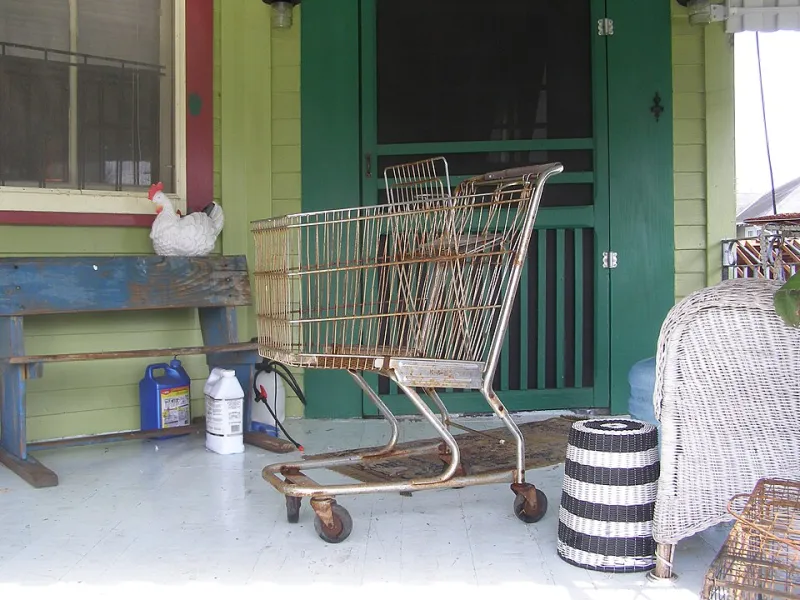
Photo: Karen Apricot, CC BY-SA 2.0, via Wikimedia Commons
Somewhere in America right now, a shopping cart is sitting in a parking lot corral, half-buried in a landscaping hedge, rolling freely across a Kroger lot. We treat these machines with casual indifference — grab one, fill it, abandon it. Which makes it easy to forget that when the shopping cart first appeared, shoppers wanted nothing to do with it.
The man who solved that problem did it with one of the savviest marketing stunts of the 20th century. And he did it from a grocery store in Oklahoma City.
A Grocer With a Weight Problem
Sylvan Goldman ran the Standard Grocery stores, a successful chain he'd built with his brother across Oklahoma. By 1936, he'd noticed a pattern that every grocer knew intimately: customers would stop shopping when their arms got tired. Two hand-held baskets was the practical limit. A family buying for a week — increasingly common as refrigerators and cars spread through Depression-era America — simply couldn't carry more.
Goldman stared at a wooden folding chair in his office and had his moment. What if you put a basket on a wheeled frame? He and a local mechanic, Fred Young, bolted two wire baskets onto a modified chair frame with casters underneath. The first shopping cart, cobbled together from a chair, a couple of baskets, and some wheels, rolled into a Standard store in 1937.
The Stunt That Made the Cart
Customers hated it.
Men thought it was effeminate — pushing a cart, they grumbled, was women's work. Women found it reminiscent of a baby carriage and felt foolish. Shoppers picked up their trusty hand baskets and ignored the strange contraption entirely.
Goldman's response was pure showmanship. He hired decoys — actors, some accounts say a mix of men and women of different ages — and paid them to push carts through his stores, looking busy, looking normal, looking like this was simply what shoppers did. Real customers, primed by social proof, slowly followed suit. Within a few months, the carts were in constant use, and Goldman's stores were ringing up larger orders than ever.
The cart spread. Rival grocers licensed the design. And Goldman, who had patented his invention, spent the rest of his life collecting royalties on one of the most quietly lucrative patents in American retail — a fortune built on a folding chair.
Eighty Years of Barely Changing
Here's the part that should make any product designer sit up: the shopping cart you push through a Walmart or a Whole Foods today is functionally identical to Goldman's 1937 model. Wire basket. Wheeled frame. Handle. Sure, there have been refinements — nesting carts for storage, plastic instead of wire, and in 1947 the addition of a child seat, which transformed the cart from a convenience into a piece of family infrastructure — but the core concept hasn't been meaningfully reinvented in nearly nine decades.
Compare that to almost any other consumer product from 1937. Cars, telephones, kitchens — all transformed beyond recognition. The cart, meanwhile, won its design argument so completely that nobody has needed to have it again.
It has also become an accidental cultural symbol. The cart abandonment problem spawned an entire field of study in behavioral economics — why do people steal carts? Why do they return them? The "shopping cart theory," a minor internet legend, holds that returning your cart is the purest test of a person's character, since no rule requires it and no reward awaits. Goldman's invention, it turns out, is now a moral parable.
The Machine That Sized the Supermarket
The cart's deepest legacy might be architectural. Supermarkets weren't designed around carts — carts forced supermarkets to redesign themselves. Wide aisles, big parking lots, checkout lanes sized for a week's worth of goods: the entire geometry of American grocery shopping is downstream of Goldman's folding chair epiphany.
So the next time you're wrestling a wonky-wheeled cart across a parking lot, spare a thought for Sylvan Goldman and his hired shoppers. The most familiar machine in your weekly routine only exists because a bunch of Oklahomans had to be convinced, by actors, that pushing one wasn't embarrassing.