The Penny Chocolate Nobody Wanted That Stocked Every Break Room in America
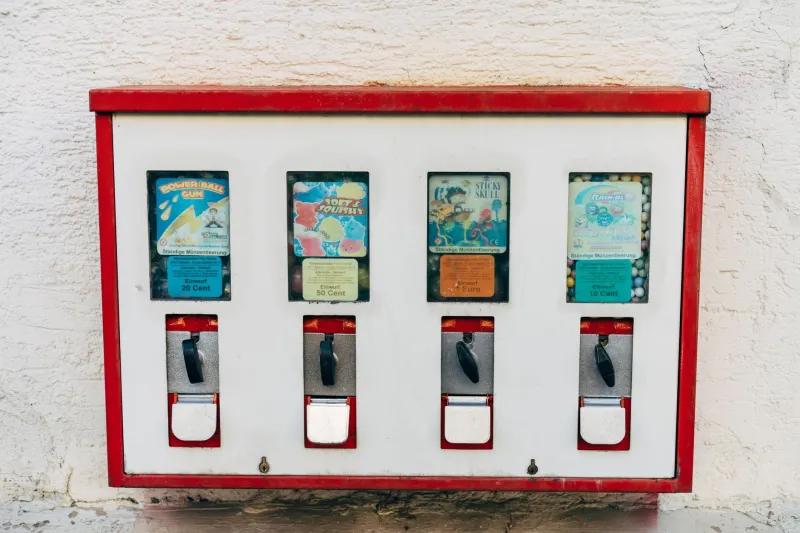
There's a vending machine within walking distance of wherever you're sitting right now. Hospital hallway, office break room, school corridor, airport gate — they're everywhere, humming quietly, waiting. You probably don't think twice about them. But the whole industry traces back to one deeply unglamorous problem: a candy maker in the early twentieth century who simply couldn't get people to buy his chocolate.
A Distribution Nightmare on the Platform
In the years just after 1900, American train travel was booming. Stations were crowded, people had coins in their pockets, and vendors were desperate to capture that foot traffic. Candy manufacturers saw an obvious opportunity — sell small, cheap confections to travelers killing time between departures.
The catch was the kiosk model itself. Staffing a counter cost money. Attendants got distracted, took breaks, and couldn't be everywhere at once. Perishable stock went unsold. For a penny chocolate that barely turned a profit on its own, the economics just didn't work.
One manufacturer — operating out of the northeast, supplying train stations with small-format chocolates — kept watching his product sit. Not because travelers didn't want candy. They did. The problem was friction: the moment between wanting something and actually buying it was just long enough for people to walk away.
His solution wasn't marketing. It was mechanical.
The Box That Sold Without a Salesman
Coin-operated machines weren't entirely new by this point. The first American vending machines had appeared in the 1880s, dispensing chewing gum on New York City elevated train platforms. But those early machines were novelties — curiosities more than commercial tools.
 Photo: New York City, via static.vecteezy.com
What changed in the early 1900s was the realization that the machine itself could solve a retail problem that no human salesperson could. It didn't take breaks. It didn't get distracted. It stood exactly where foot traffic was highest and waited.
When candy manufacturers started placing coin-operated dispensers directly on station platforms — no attendant required — something unexpected happened. Sales didn't just hold steady. They climbed. The removal of human interaction, counterintuitively, made people more willing to buy. There was no awkward exchange, no pressure, no judgment. Just a coin, a lever, and a reward.
That psychological dynamic — anonymous, frictionless, immediate — turned out to be the real invention. The chocolate was almost beside the point.
Engineering the Impulse
Once the model proved itself in train stations, manufacturers and machine operators began studying it obsessively. Why did people stop at some machines and walk past others? Why did certain products outperform identical ones placed differently?
What they discovered, through decades of trial and error, was that vending wasn't passive retail. It was architecture.
The height of the product window mattered. The visibility of the item inside mattered. The sound of the coin dropping mattered. The slight delay before the product released — just long enough to build a half-second of anticipation — mattered enormously. These weren't accidents. By mid-century, machine manufacturers were deliberately engineering every sensory detail of the transaction.
The snack industry followed. Candy companies began designing products specifically for vending format: portion sizes calibrated to price points, packaging engineered to stay visible behind a scratched plastic window, flavors chosen partly for how well they photographed in a display slot.
This is the part of the story that tends to get lost. The American snack industry didn't grow up in grocery stores. It grew up in machines. The formats, sizes, and even flavor profiles of dozens of familiar products were shaped by what worked inside a metal box on a factory floor or a school hallway.
From Stations to Everywhere
World War II accelerated everything. Factories running around the clock needed to feed workers on irregular schedules. Cafeterias couldn't keep up. Vending machines — already proven technology — moved into industrial settings by the thousands, dispensing not just candy but crackers, peanuts, and eventually hot drinks.
 Photo: World War II, via digital-classroom.nma.gov.au
By the postwar boom, the machine had followed the American worker everywhere. Suburban office parks, hospitals, universities, and department stores all adopted the model. The vending industry grew from a transportation novelty into essential infrastructure, embedded so deeply into American daily life that it became invisible.
Modern snack machines are, in many ways, the direct descendants of that original platform dispenser — just with digital screens, cashless payments, and inventory sensors that alert distributors when the Doritos run low. The mechanics evolved. The underlying logic didn't.
What a Penny Chocolate Actually Built
It would be easy to frame this as a story about capitalism finding a more efficient way to sell things. But there's something more interesting buried in it.
The vending machine succeeded not because it was a better salesperson, but because it removed the human element from a transaction people already wanted to make. It turned a moment of hesitation into an automatic yes. That insight — that friction is the enemy of a sale, and that reducing it changes behavior — became foundational to retail psychology, and eventually to digital commerce.
Every one-click purchase, every auto-filled checkout form, every app that stores your payment details is chasing the same frictionless moment that a coin-operated chocolate box stumbled onto in a train station over a hundred years ago.
The candy nobody wanted built a template that now shapes how billions of dollars change hands every day. Not bad for a penny chocolate.