The Ancient Weapon Check That Became America's Most Trusted Business Gesture
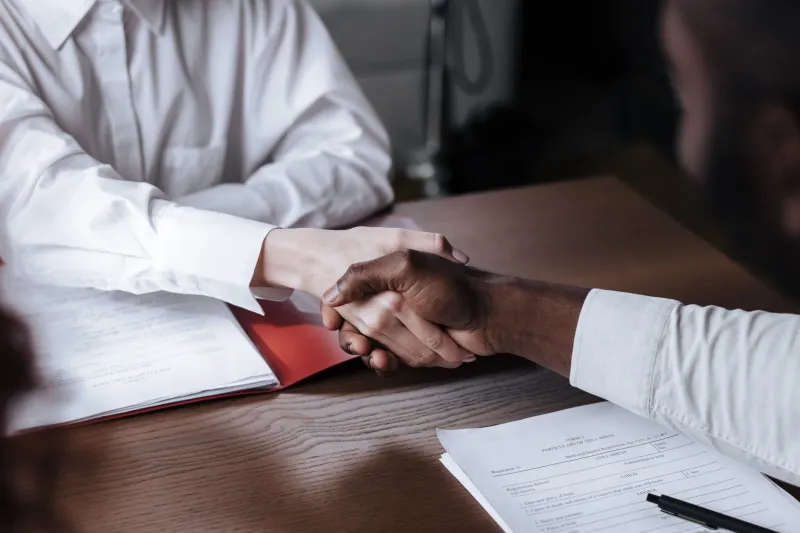
Think about the last time you shook someone's hand before a business meeting. You probably didn't think about it at all — that's the point. The handshake is so deeply embedded in American professional culture that doing it feels like breathing. Not doing it feels like a statement.
But the reason you extend your right hand, grip firmly, and pump once or twice has almost nothing to do with warmth or professionalism. It has to do with swords.
When the Hand You Extended Was the Hand That Might Kill You
The most widely accepted origin of the handshake places it in medieval Europe, specifically in the context of knights and soldiers meeting under uncertain terms. When two armed men approached each other — at a truce, a negotiation, the end of a battle — each needed some assurance that the other wasn't about to reach for a weapon.
Extending your right hand openly, palm visible, was a way of showing that hand was empty. Grasping the other person's forearm — the original form of the gesture, before it migrated down to the palm — made it physically difficult to draw a blade. You were, in the most literal sense, holding the weapon arm of a potential enemy while showing them yours was clear.
The pumping motion that we still use today may have served a secondary purpose: shaking the arm up and down would dislodge any blade that might be hidden up a sleeve. It sounds paranoid. It was meant to be.
This was not a gesture of friendship. It was a gesture of mutual verification. The message wasn't "I like you." It was "I am not currently trying to kill you, and I'm asking you to confirm the same."
The Quakers Helped Clean It Up
The handshake carried its military associations for centuries before it got a meaningful rebranding. That rebranding came, somewhat unexpectedly, from the Quakers.
In 17th-century England, the Society of Friends — the Quakers — rejected most of the formal social rituals of their time. Bowing, removing hats, using honorific titles: all of these were seen as expressions of social hierarchy that contradicted their belief in the equality of all people before God. They needed an alternative greeting, one that was respectful without being deferential.
The handshake fit. It was direct, physical, and symmetrical — both parties performed the same gesture at the same time, which made it inherently egalitarian. No one was bowing to anyone. The Quakers adopted it enthusiastically and, because they were active traders and merchants across England and the American colonies, they spread the practice widely through commercial networks.
By the time the handshake arrived in early American business culture, it had been laundered through enough Quaker commerce that its original battlefield logic was mostly forgotten. What remained was the sense of mutual commitment — the idea that a handshake meant something, that it was a binding signal between two parties.
How It Became an American Business Institution
America, as a commercial culture built significantly by those same Quaker merchant networks, absorbed the handshake early and made it central to how deals were done. In the 18th and 19th centuries, when formal legal contracts were slow, expensive, and not always enforceable, a handshake carried genuine weight. "A handshake deal" wasn't a metaphor for informality — it was often the actual mechanism of a transaction.
The phrase "my word is my bond" was backed up by the physical act. Refusing to shake someone's hand was a serious social signal, roughly equivalent to calling them untrustworthy in public. Offering a weak or evasive handshake was read as a character flaw. The gesture had accumulated so much cultural freight that it functioned almost like a legal instrument in small-scale commerce.
As American business formalized through the 19th and 20th centuries, the handshake didn't fade — it migrated upward. It became the opening and closing ritual of every serious professional interaction: job interviews, sales meetings, contract signings, negotiations. Entire books were written about handshake technique. Business schools taught it. Etiquette coaches built careers around it.
The Rules That Survived Into the Boardroom
Some of the handshake customs that American business culture still enforces are direct descendants of those original medieval and Quaker-era norms, even if no one remembers why.
The firm grip, for instance, is still widely interpreted as a signal of confidence and reliability — a soft handshake still makes people uncomfortable in ways they struggle to articulate. This likely traces back to the original function of the grasp: a weak grip meant you weren't actually securing the other person's weapon arm, which meant you weren't taking the verification seriously.
Making eye contact during a handshake is another persistent rule. Looking away while grasping someone's hand reads as evasive or untrustworthy. In the original context, looking away from someone while physically connected to them was simply dangerous.
The right hand remains the standard — left-hand handshakes are still unusual enough to register as odd in most American business settings. This is partly because most people are right-handed and the right hand was historically the sword hand, making it the one that needed to be shown empty.
A Gesture Older Than the Country
The COVID-19 pandemic briefly raised the question of whether the business handshake might finally be retired — elbow bumps and nods made a run at replacing it for a while. But by most accounts, the handshake came back. Quickly, and with relatively little resistance.
That resilience makes sense when you trace the gesture back far enough. The handshake isn't just a professional courtesy. It's one of the oldest trust technologies humans ever developed — a physical protocol for establishing good faith between strangers who have every reason to be suspicious of each other.
When you shake someone's hand before a meeting, you're doing what soldiers did on a medieval battlefield. You're saying: I'm showing you my weapon hand. I'm asking you to show me yours. Now let's talk.