The Office Utopia That Corporations Quietly Turned Into a Cage
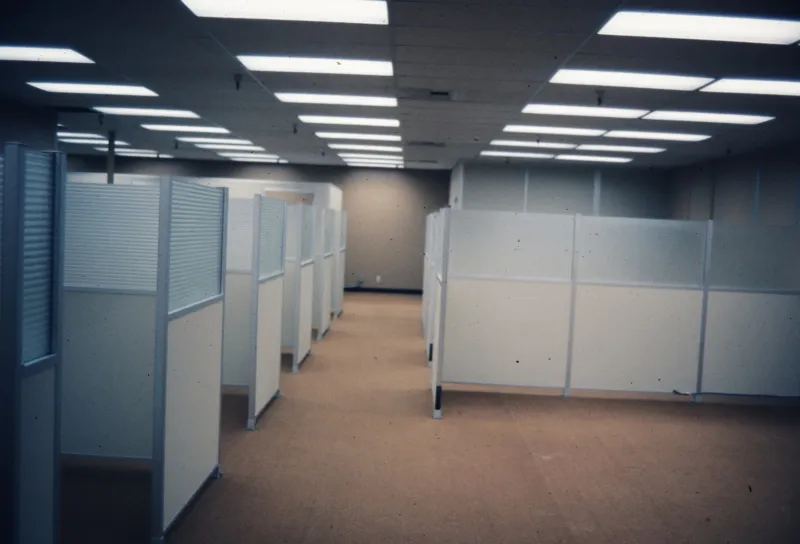
Photo: San Diego Air & Space Museum Archives, Public domain, via Wikimedia Commons
If you've ever stared at a gray fabric wall from three feet away and wondered how humanity arrived at this particular low point, you're asking the right question. The cubicle — that squat, carpeted box that has housed the quiet despair of millions of American office workers — was not designed to make you miserable. It was actually designed to set you free.
The story of how a genuinely idealistic piece of furniture became synonymous with soul-crushing monotony is one of the stranger reversals in American design history.
The Man Who Wanted to Liberate the Worker
In 1960, a designer named Robert Propst was working at Herman Miller, a Michigan-based furniture company. Propst was not a man who thought small. He had already designed everything from heart valves to industrial equipment, and when Herman Miller pointed him toward the American office, he saw a problem worth solving.
The offices of the early 1960s were grim in a very specific way. Row after row of identical desks sat under fluorescent lights, with workers arranged like items on a warehouse shelf. Managers and executives, meanwhile, occupied private offices with actual walls and doors — the so-called corner office being the ultimate status symbol. The hierarchy wasn't just organizational. It was architectural. You could tell exactly where you ranked by how much wall space surrounded you.
Propst found this arrangement intellectually offensive. He spent years studying how people actually worked — how they needed to move, shift tasks, stand up, pin things to surfaces, and reconfigure their environment throughout the day. He interviewed workers, observed behavior, and came to a conclusion that felt almost radical: the standard office was making people less productive and less human at the same time.
His solution, unveiled in 1968 under the name the Action Office II, was a modular panel system that workers could arrange themselves. The panels were tall enough to provide privacy and acoustic separation, but low enough that people could see over them and connect with colleagues. Workstations could be reconfigured. Height-adjustable surfaces let people stand or sit. The whole system was designed around the idea that no two workers were the same and no two jobs required the same environment.
Propst called it a tool for human dignity. He genuinely believed it would flatten office hierarchies and give workers a sense of ownership over their space.
How the Dream Curdled
Here's where the story takes its inevitable turn.
Corporate America looked at the Action Office II and saw something completely different from what Propst intended. What they saw was a cheap, flexible way to pack more workers into less square footage.
The panels could be arranged in small clusters. The smaller the cluster, the more clusters you could fit in a floor plan. The more clusters, the more workers per building. And unlike building permanent offices, the panels could be reconfigured without a construction crew. Real estate costs dropped. Overhead shrank. The modular system that was supposed to give workers freedom became the mechanism for compressing them.
By the mid-1970s, the Action Office had been stripped down and standardized by dozens of manufacturers copying the basic format. The adjustable surfaces disappeared. The generous dimensions shrank. The thoughtful configurations that Propst imagined — open, flowing, personal — gave way to uniform grids of identical boxes lined up like cells in a beehive.
Propst watched this happen in real time and was not quiet about his disgust. He later called the configurations that emerged "monolithic insanity" and said that what companies built bore almost no resemblance to what he designed. He died in 2000, still frustrated that his most famous invention had become the thing he most wanted to dismantle.
The Cubicle Becomes a Cultural Punchline
By the 1980s and 1990s, the cubicle had fully calcified into the form most Americans recognize today. And American pop culture wasted no time burying it.
Dilbert, Scott Adams' comic strip launched in 1989, made the cubicle its primary setting and turned it into a shorthand for everything hollow about corporate life. Office Space, the 1999 Mike Judge film, practically turned the cubicle into a character — a physical manifestation of the slow death of ambition. The word itself became a punchline, a shorthand for a certain kind of quiet professional suffering.
And yet, even as everyone agreed the cubicle was terrible, it didn't go away. By some estimates, roughly 40 million Americans still work in cubicle-style environments. The format proved remarkably durable precisely because it served corporate real estate economics so efficiently.
The Open Office Didn't Fix It Either
In the 2010s, Silicon Valley declared the cubicle dead and replaced it with open floor plans — long communal tables, no dividers, maximum visibility. This was marketed as the antithesis of cubicle culture: collaborative, transparent, egalitarian.
Except workers hated those too. Studies found that open offices actually reduced face-to-face interaction (people put on headphones and retreated inward), increased distraction, and lowered productivity. The irony was almost too neat: the replacement for the thing that was supposed to be liberating but became oppressive turned out to also be liberating in theory and oppressive in practice.
Propst's original insight — that workers need privacy, flexibility, and agency over their environment — turned out to be correct all along. The problem was never the panel system. It was that corporations kept using new design philosophies to solve a real estate problem while calling it a human one.
What the Cubicle Actually Tells Us
Trace the cubicle back far enough and you find a genuine attempt to make work more humane. What happened to that idea is less a design story than an economic one: good intentions tend to survive exactly as long as they don't cost anything.
The next time you're sitting in your cubicle, or your open office, or your hot desk — staring at a screen, wondering how it came to this — remember that someone, once, thought this was going to be different. He was right about what workers needed. He just didn't account for who was paying for the furniture.