From Barley Tablets to Amazon Returns: The Ancient Bureaucratic Trick Behind Every Receipt You've Ever Kept
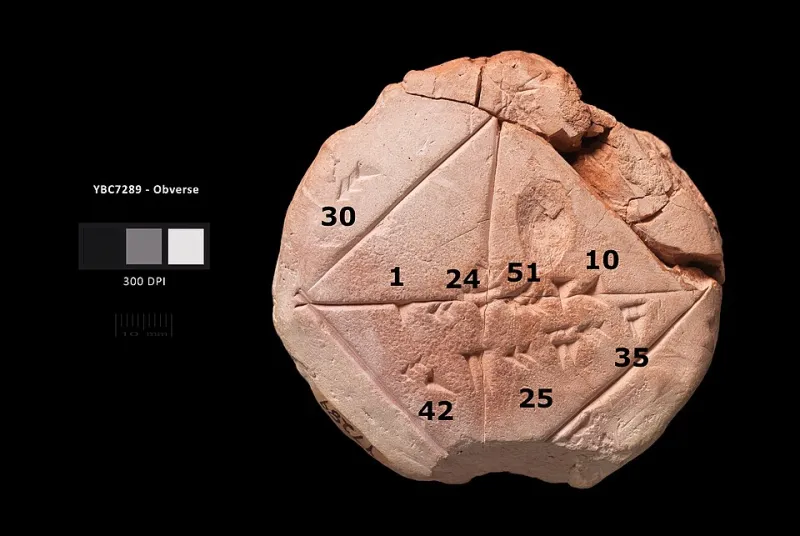
Photo: Urcia, A., Yale Peabody Museum of Natural History, https://peabody.yale.edu, http://hdl.handle.net/10079/8931zqj derivative work, user:Theodor Langhorne Franklin, CC0, via Wikimedia Commons
From Barley Tablets to Amazon Returns: The Ancient Bureaucratic Trick Behind Every Receipt You've Ever Kept
Somewhere in your wallet, crumpled at the bottom of a grocery bag, or buried in an email folder you haven't opened in months, there's a receipt. You barely looked at it when it was handed to you. You almost certainly won't look at it again. And yet, that flimsy piece of paper — or its digital equivalent — is one of the most consequential documents in the history of human commerce.
The receipt is older than money. It's older than writing itself, in any form we'd recognize. And the reason it still exists, in essentially the same functional form it took six thousand years ago, is that it solved a problem so fundamental to human exchange that nobody has ever found a better solution.
Clay, Grain, and the World's First Paper Trail
Around 3000 BCE, in the river valleys of ancient Mesopotamia — modern-day Iraq — the world's first large-scale economies were taking shape around grain storage. Temples and city administrators collected barley and wheat as tax, distributed it as wages, and traded it across regions. The quantities were enormous. The opportunities for fraud, miscounting, and simple honest error were equally enormous.
The solution was the clay tablet. Scribes pressed cuneiform symbols into wet clay to record what had been received, from whom, in what quantity, and when. These tablets weren't art or literature — they were administrative records, the ancient equivalent of a POS system printout. Thousands of them have survived, buried in the ruins of cities like Ur and Uruk, and the majority of them are essentially receipts: "47 jars of oil received from the storehouse of the temple, third month, year of the great flood."
The tablet served a specific legal purpose. If a merchant claimed he'd delivered grain and the storehouse claimed he hadn't, the clay record settled it. The physical document was the proof. That logic — that a written record of a transaction protects both parties — has never been improved upon. It's just been reproduced on progressively thinner materials.
Rome Turns Bureaucracy Into Infrastructure
The Romans, characteristically, took someone else's good idea and scaled it into an empire-wide system. Roman tax collectors — the much-despised publicani — were required to issue written documentation for every payment they collected. This wasn't generosity toward taxpayers. It was accountability for the collectors, who had a well-earned reputation for skimming.
Roman commercial law also required written records for property transfers, loan agreements, and large purchases. The tabula — a wax-coated wooden tablet that could be inscribed and reused — became the standard transaction document across the empire. Merchants kept copies. Buyers kept copies. Courts accepted them as evidence.
What Rome actually built, underneath all its roads and aqueducts, was a documentation culture. The idea that a transaction wasn't real until it was written down, and that the written record had legal standing, became embedded in Western commercial practice so deeply that it survived the fall of the empire itself.
Medieval European merchants inherited this assumption without questioning it. Florentine banking houses in the 14th century kept meticulous double-entry records partly because they'd inherited Roman notions of documented accountability. The handwritten receipt traveled from clay to wax to parchment to paper without ever changing its fundamental purpose.
America Inherits the Habit — Then Legislates It
The American colonies brought English commercial law with them, and English commercial law was thoroughly Roman in its documentation instincts. Colonial merchants issued handwritten receipts as a matter of course. The word itself comes from the Latin receptus — meaning something received — which tells you exactly how old the concept is.
But the receipt's role in American life shifted dramatically in the twentieth century, when consumer protection became a legislative priority. The Federal Trade Commission, established in 1914, began building a regulatory framework that treated the transaction record as a consumer's primary defense against fraud. Subsequent decades layered on more: the Truth in Lending Act of 1968 required creditors to document terms in writing. The Magnuson-Moss Warranty Act of 1975 established that written warranties were legally binding documents. The Tax Reform Act of 1986 tightened requirements for documented deductions.
Every one of these laws rested on the same assumption the Mesopotamian grain scribes had made six thousand years earlier: the written record of a transaction is what makes that transaction real and enforceable.
The Receipt You Almost Threw Away Is Doing Legal Work
Today, the receipt is so thoroughly woven into American consumer infrastructure that its absence is alarming. No receipt means no return. No receipt means no warranty claim. No receipt means the IRS doesn't have to take your word for it. The paper trail isn't a courtesy — it's a legal instrument.
The shift to digital receipts hasn't changed the function at all. An emailed receipt from Amazon carries exactly the same evidentiary weight as a clay tablet from Ur. It records what was exchanged, between whom, and when. Courts accept it. Insurance companies require it. The IRS expects it.
What's remarkable is how little the underlying logic has changed across six millennia. The Mesopotamian scribe pressing a stylus into clay and the Walgreens register printing a thermal receipt are performing the same act: creating a shared, durable record of what just happened so that neither party can later claim it didn't.
The materials got lighter. The bureaucracy got bigger. The barley became a flat-screen TV on installment payments.
But the receipt? The receipt stayed exactly what it always was — the thing that makes a deal a deal.