How the Navy's Tool Problem Accidentally Organized Every Garage in America

Photo: Galt Museum & Archives on The Commons, No restrictions, via Wikimedia Commons
The Problem With Tools on a Moving Ship
Imagine trying to maintain a military aircraft on a surface that tilts, vibrates, and occasionally gets hit by enemy fire. The flight decks of World War II aircraft carriers were among the most demanding work environments ever created — deafeningly loud, perpetually in motion, and crammed with personnel and machinery sharing space that was never quite enough.
For the mechanics and aviation ordnancemen responsible for keeping carrier-based planes operational, the tool situation was a genuine crisis. Tools stored in boxes or drawers slid around, got buried, took time to locate, and in the worst cases went overboard. Time spent hunting for a wrench was time a plane sat unserviceable. And on a carrier in the Pacific, an unserviceable plane wasn't just a maintenance problem — it was a tactical one.
The Navy needed a storage solution that kept tools visible, accessible, and locked in place without requiring a cabinet or a flat surface. What emerged from that pressure would eventually hang in tens of millions of American garages.
The Wall That Held Everything
The core innovation was simple in concept but genuinely clever in execution: a panel of sheet metal punched through with evenly spaced holes, designed to accept a variety of hooks, brackets, and holders that could be repositioned as needs changed. Tools hung on the wall. Every tool had a designated spot. Every spot was visible at a glance. Nothing rolled away.
The system — which would eventually be known generically as pegboard, though the trade name Masonite Pegboard and later the Presdwood Pegboard became widely used — gave mechanics something they'd never had before: a storage wall that was also an inventory system. If a hook was empty, a tool was missing. You didn't need to dig through a box to find out what was gone.
On an aircraft carrier, that visibility was the difference between a five-second tool grab and a two-minute search. Multiplied across hundreds of mechanics running maintenance cycles on dozens of aircraft, the time savings were significant. The Navy standardized the approach, and it spread across the fleet.
Coming Home With the Veterans
When the war ended and millions of American servicemen came home, they brought habits with them. The veteran who'd spent three years maintaining aircraft on a carrier deck had a very particular understanding of how a workspace should be organized. Tools on the wall. Everything in its place. Nothing buried.
The timing couldn't have been better for the American hardware industry. The postwar housing boom was creating suburbs at a pace the country had never seen, and those suburbs came with something the urban apartment never had: the garage. Suddenly, millions of American households had a dedicated space for tools, projects, and the particular kind of weekend tinkering that became a defining feature of postwar domestic life.
Hardware manufacturers recognized the opportunity almost immediately. The Masonite Corporation, which had been producing hardboard panels for industrial use, began marketing perforated hardboard panels for home workshop use in the late 1940s and into the 1950s. The hook-and-panel system that veterans recognized from their service days was now available at the hardware store for a few dollars.
 Photo: Masonite Corporation, via vontobels.com
It sold extraordinarily well.
Stanley and the Standardization of the American Workshop
The hardware industry moved quickly to standardize the accessory ecosystem around pegboard. Stanley Tools — already one of the most recognized names in American hardware — developed an extensive line of hooks, brackets, and specialized holders designed to fit the standard quarter-inch hole pattern that had become the industry norm.
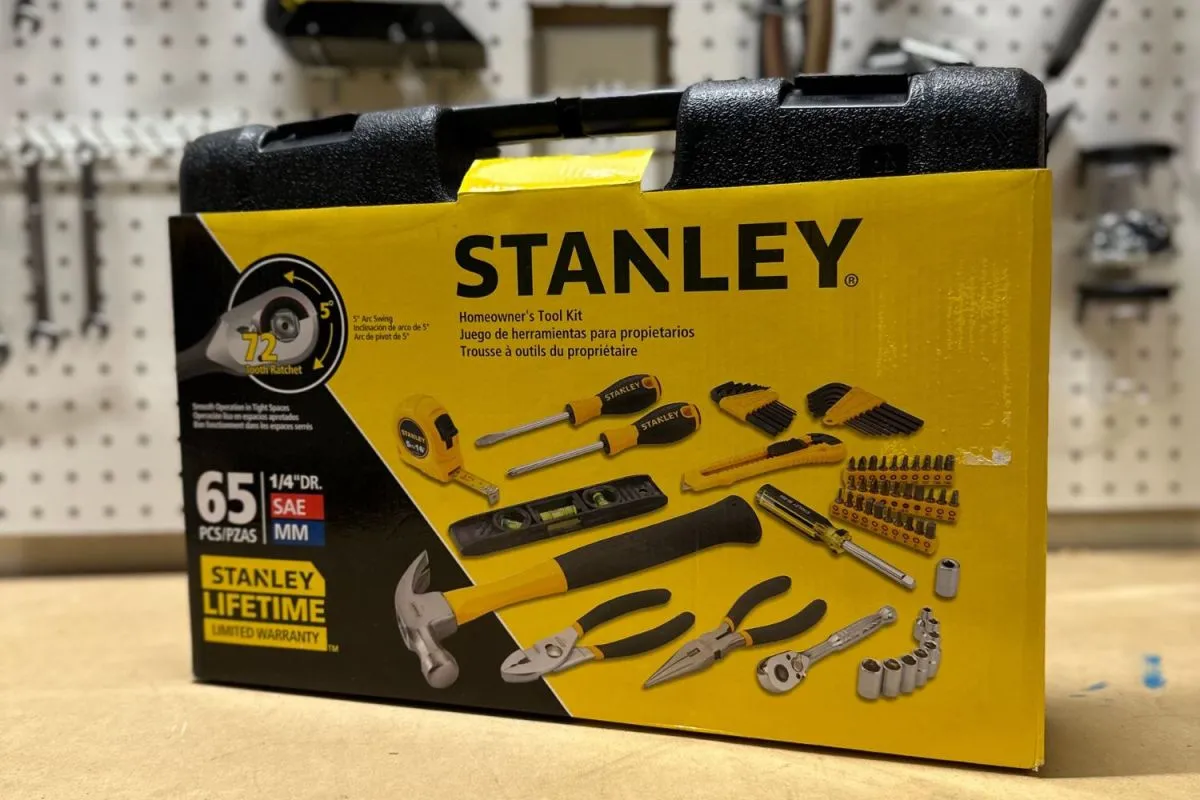 Photo: Stanley Tools, via www.bobvila.com
That standardization was crucial. It meant that a hook bought from one manufacturer would fit a panel from another, which gave consumers confidence that investing in a pegboard setup wasn't a dead end. The interchangeability of components turned pegboard from a product into a platform — and platforms, once they reach critical mass, tend to become permanent.
By the mid-1950s, pegboard had migrated from the workshop into the retail store. Merchants discovered that the same visibility and accessibility that made pegboard useful for mechanics made it equally useful for displaying merchandise. Products hung at eye level, clearly visible, easy to grab — it was the same logic, applied to a selling environment.
The retail display industry adopted pegboard hooks so thoroughly that the hook-and-panel system became the default architecture for hardware stores, craft stores, and eventually big-box retailers. The next time you're standing in a Home Depot aisle looking at a wall of hanging merchandise, you're looking at a direct descendant of a carrier deck storage solution from 1943.
 Photo: Home Depot, via paradehomeandgarden.com
The Garage as American Institution
The pegboard's cultural impact went beyond organization. It helped define what the American garage was for.
Before the postwar boom, garages were primarily for cars. But as pegboard made tool storage practical and visible, the garage began to evolve into something more — a workshop, a hobby space, a room where things got built and fixed and tinkered with. The organized workshop wall, with its tools hanging in neat rows, became a symbol of a particular kind of American self-sufficiency.
This wasn't accidental. Pegboard made the tools visible, and visible tools invited use. A wrench hanging on a hook is a prompt; a wrench buried in a drawer is forgotten. The organizational logic of pegboard actively encouraged the kind of hands-on engagement that turned the American garage into a cultural archetype — the birthplace of Apple, the first workshop of countless small businesses, the space where a generation of Americans learned to build things.
Still on the Wall
Today, pegboard remains a staple of American hardware stores, sold in standard four-by-eight sheets alongside bins of hooks in every size and configuration. The basic design hasn't changed meaningfully in seventy years. The quarter-inch hole pattern that naval mechanics worked around is the same one a homeowner drills into their garage wall today.
The material has evolved — you'll find versions in metal, plastic, and composite board alongside the original hardboard — but the concept is identical. A wall full of holes. Hooks that hold things. Everything visible, everything accessible, nothing lost.
It's not a glamorous invention. It doesn't have a famous origin story or a celebrated inventor. But it solved a real problem under extreme conditions, and it turned out that the same problem existed in every garage in America. The Navy just found the answer first.