The Pencil Eraser Was Considered a Bad Idea — Until American Classrooms Forced Everyone to Change Their Minds
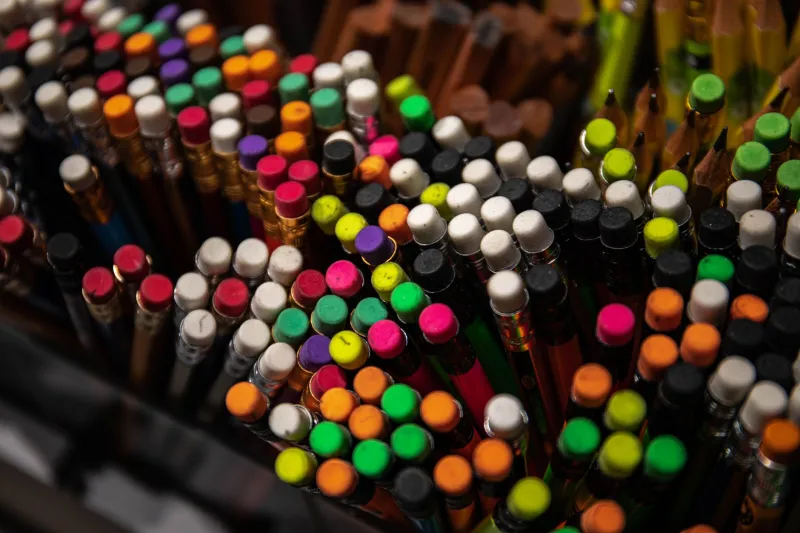
Pick up a standard pencil and the eraser on the end feels so obvious, so correct, that it's hard to imagine the object without it. But for a long stretch of pencil history, that little pink nub didn't exist — and the people who made pencils thought attaching one was a mistake.
The story of how it got there anyway is less about invention and more about institutional demand. It's a case where the users — specifically, millions of American schoolchildren — drove a design change that manufacturers had actively resisted. And the ripple effects of that shift shaped the look of the pencil for the next century and a half.
The Pencil Before the Eraser
Graphite pencils had been around since the mid-1500s, when a large deposit of unusually pure graphite was discovered in Borrowdale, England. For the first couple of centuries, pencils were luxury items — rough graphite sticks wrapped in string or inserted into holders. Mass production didn't really arrive until the early 1800s, when manufacturers in Germany and later the United States figured out how to mix powdered graphite with clay and press it into consistent rods.
At this point, erasing was a separate activity. Writers and artists used small pieces of rubber — which had only recently been identified as useful for removing graphite marks — kept in a separate case or drawer. The pencil was for writing. The eraser was a different tool entirely. Nobody had thought to combine them, but more importantly, nobody had particularly wanted to.
The Patent That Started the Argument
In 1858, a Philadelphia man named Hyman Lipman received a patent for a pencil with a small piece of rubber glued into a groove at one end. It wasn't a complicated invention. The patent itself acknowledged that both pencils and erasers already existed — Lipman's contribution was simply attaching them.
The pencil manufacturing industry's response was somewhere between indifferent and hostile. Established manufacturers viewed the combination as a cheapening of both products. There was a genuine professional snobbery at work: serious writers, draftsmen, and artists used quality tools, and a pencil with a rubber stub on the end smacked of carelessness. It implied you expected to make mistakes. Some manufacturers argued — with a straight face — that the attached eraser would encourage sloppy work.
Lipman's patent was eventually challenged and invalidated in 1875 on the grounds that combining two existing items didn't constitute a novel invention. The legal ruling essentially opened the design to anyone, but most manufacturers still didn't rush to adopt it. The combination pencil remained a novelty rather than a standard product.
The Classroom Changes the Calculation
What shifted the economics was scale — specifically, the scale of American public education.
Through the latter half of the 1800s, public school enrollment in the United States was growing rapidly. By the 1880s and 1890s, school systems in major cities were purchasing supplies in quantities that manufacturers couldn't ignore. And the people making purchasing decisions for those school systems had a very specific problem: young children lost things.
A student who kept their pencil and eraser as separate items would, with near certainty, lose one or the other within a week. Separate tools meant separate budgets for replacements, separate tracking, and constant classroom interruptions when a child couldn't find their eraser. School administrators and teachers began requesting — and then demanding — pencils with erasers already attached.
Those requests came with volume attached. A single school district order could represent thousands of pencils. When enough districts made the attached eraser a purchasing requirement, manufacturers who had resisted the design suddenly had a financial reason to reconsider their principles.
The American Standard Becomes the Global Standard
By the early 1900s, the eraser-tipped pencil had become standard in American manufacturing — not because the industry had a change of heart, but because the American school system had effectively mandated it through purchasing power. Companies that wanted the school contract made the pencil with the eraser. Companies that made the pencil with the eraser started making all their pencils that way, because maintaining two separate product lines wasn't worth the cost.
This is where the story gets geographically interesting. European pencil manufacturers — particularly in Germany, which dominated global pencil production — held out considerably longer. Many continued to view the attached eraser as an American peculiarity, a concession to a less disciplined market. European pencils sold without erasers well into the 20th century, and in some professional contexts, the separation of pencil and eraser remains a point of preference to this day.
The difference wasn't about design philosophy. It was about who the customer was. American manufacturers were selling to a mass public school market that had very particular needs. European manufacturers were still oriented toward professional and commercial buyers who had different expectations. Same product, different customer, completely different outcome.
What This Reveals About How Conveniences Get Standardized
Most people assume that the features built into everyday objects exist because someone smart designed them that way. The pencil eraser flips that assumption. Nobody at a pencil company woke up one morning and decided the attached eraser was a great idea. The industry actively resisted it. The feature became standard because enough institutional buyers demanded it in enough bulk that resistance became more expensive than adoption.
This pattern — user demand driving standardization rather than designer intent — shows up more often than we tend to recognize. The features we take for granted in everyday objects frequently got there not because they were planned but because someone, somewhere, needed them badly enough and bought enough product to make the change inevitable.
The pencil eraser is a small thing. But it's a reminder that the objects we use without thinking often carry the fingerprints of forgotten arguments, institutional pressures, and purchasing decisions made by people who just needed their students to stop losing their erasers.
The manufacturers who thought it would encourage sloppy work were, in a sense, right. It did. And it turned out that was completely fine.