The Three-Month Mattress Flip Was Never About Sleep — It Was About Anxiety
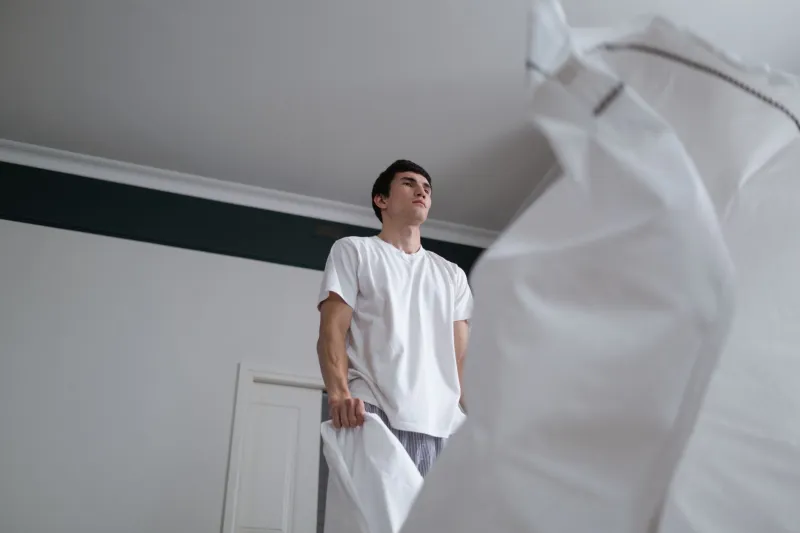
Somewhere between changing the furnace filter and cleaning the gutters, flipping the mattress sits quietly on the American home maintenance checklist. People do it every three months, or feel vaguely guilty when they don't. Parents passed it down to their kids like a sacred seasonal duty. Some people even set calendar reminders.
Here's the thing: most mattress manufacturers have been telling customers to stop doing it for decades. And almost nobody listened.
Where the Ritual Actually Came From
To understand why Americans flip mattresses with the devotion of a religious observance, you have to go back to the 19th century — to beds that were genuinely terrible and genuinely needed attention.
Victorian-era mattresses weren't the engineered foam blocks we sleep on today. They were filled with loose materials: horsehair, wool, cotton batting, or feathers. Under the pressure of a human body sleeping in the same position night after night, those fillings would compress unevenly, creating hard lumps in some spots and flat, unsupportive hollows in others. The only way to restore anything resembling comfort was to physically redistribute the stuffing — which meant flipping, rotating, and sometimes opening the mattress entirely to manually rearrange what was inside.
This wasn't optional maintenance. It was survival. A mattress that wasn't regularly turned became genuinely unusable within months.
When coil spring mattresses arrived in the late 1800s and became widely accessible through the early 20th century, the logic transferred almost perfectly. Metal springs under sustained one-directional pressure would fatigue and sag. Rotating the mattress gave each section of springs a chance to decompress. Flipping it distributed wear across both sides. The habit made complete mechanical sense, and it became embedded in American domestic culture during a period when most households were still using some version of these materials.
By the time your grandparents were setting up their first home, flipping the mattress was simply what you did. It was listed in household management guides. It was the kind of thing a responsible homeowner knew.
The Moment the Logic Disappeared
The mattress industry quietly underwent a revolution in the latter half of the 20th century, and it changed everything about why — or whether — you should be flipping anything.
Modern innerspring mattresses are engineered with multiple distinct layers: a comfort layer on top, support layers in the middle, and a firmer base at the bottom. These layers are specifically designed to work in one direction. Flipping them puts the firm base layer on top, which means you're sleeping on the wrong side of a mattress that was never intended to be used that way. Memory foam and latex mattresses operate on the same principle — they're constructed with a deliberate orientation.
Major manufacturers began communicating this openly in the 1990s and 2000s. Sealy, Serta, and Tempur-Pedic all shifted to single-sided designs and updated their care instructions accordingly. The message was clear: stop flipping. Rotate if you want, but flipping is counterproductive.
And yet, the quarterly mattress flip persisted in American households like a ghost that hadn't been told it was dead.
Why We Keep Doing Things That No Longer Work
The persistence of the mattress flip is actually a fascinating case study in how habits survive long after their original context disappears.
Part of it is generational transmission. When a behavior gets passed down from parents to children as household knowledge, it carries a kind of implicit authority. Your mother flipped the mattress. Her mother flipped the mattress. Questioning it feels less like critical thinking and more like disrespecting the family.
Part of it is the comfort of ritual itself. There's something psychologically reassuring about seasonal maintenance tasks. They create a sense of control over the home environment. Even if the specific action no longer does what it once did, the act of doing something structured and purposeful scratches a real itch.
And part of it is that nobody really checks. Unlike, say, changing your car's oil — where skipping it produces a very obvious and expensive consequence — sleeping on an unflipped mattress produces no immediately detectable outcome. The habit continues because there's no feedback loop to challenge it.
Behavioral researchers call this kind of thing a "zombie habit" — a behavior that keeps moving long after the original rationale has died. The mattress flip is a near-perfect example. The action survived intact while the entire material context that justified it was replaced.
What You Should Actually Be Doing
If you have a modern memory foam, hybrid, or single-sided innerspring mattress, the manufacturer guidance is almost universally the same: rotate it 180 degrees head-to-foot every six months or so. This distributes wear across the length of the mattress without inverting the layer structure. Don't flip it.
If you somehow own an older double-sided innerspring mattress — the kind with identical construction on both faces — then yes, flipping still makes sense. But those mattresses are increasingly rare, and if you're buying new, you almost certainly don't have one.
The mattress flip isn't harmful, exactly. It's mostly just pointless for most people in most homes. But it's a vivid reminder that the things we inherit as household wisdom were often built for a completely different world — and we don't always notice when that world has changed.
Your Victorian great-great-grandmother, wrestling with a horsehair mattress in a farmhouse, was doing something genuinely necessary. You, setting a phone reminder to flip your Casper, are performing a ritual in her honor without knowing it.
There are worse things to inherit.