Why Your Highlighter Is Yellow: The Accidental Color Choice That Rewired How We Study

The Color You Never Questioned
Pull open a desk drawer almost anywhere in America and you'll probably find one — that fat, translucent yellow marker you've been reaching for since middle school. It's so familiar it barely registers as a choice anymore. Yellow highlighter is just what a highlighter is.
But here's the thing: it didn't have to be yellow. The color wasn't chosen because someone ran studies, consulted psychologists, or tested it against alternatives. It was chosen because of what was available. And the full story of how that happened is stranger and more interesting than the marker sitting in your drawer would ever suggest.
Markers Before Highlighting Was a Thing
To understand where the highlighter came from, you have to go back to the felt-tip marker — a technology that itself has a more complicated history than most people realize.
The first commercially successful felt-tip marker was developed in Japan in the early 1960s by Yukio Horie, whose company would eventually become Pentel. These early markers were designed for writing, not highlighting — bold, opaque, and meant to be seen clearly on their own. The ink sat on top of paper rather than soaking through it.
The leap to a translucent, see-through ink — the kind that lets you read the text underneath — required a different formulation entirely. Carter's Ink Company in the United States began experimenting with this concept in the mid-1960s, and the product that emerged, the Hi-Liter, hit the American market around 1963 to 1965 depending on the source. Avery Dennison later became closely associated with the product's mass-market success.
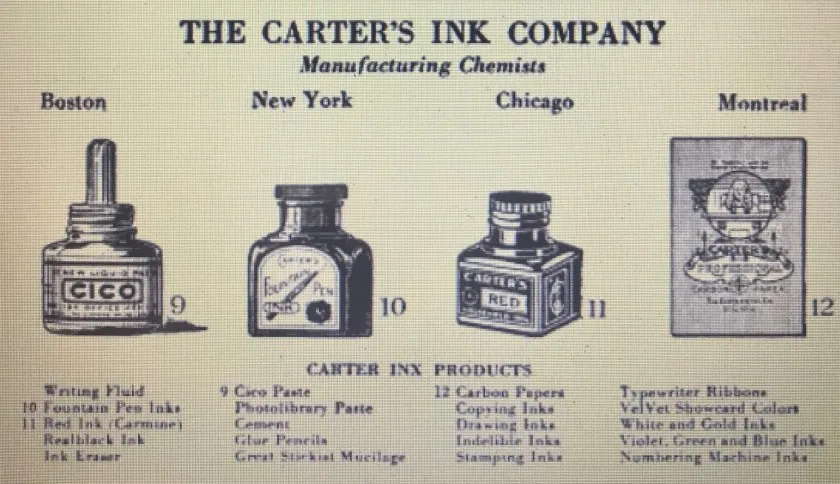 Photo: Carter's Ink Company, via i1.wp.com
The question of color came down to what the ink could actually do.
What the Shortage Had to Do With It
Translucent inks are chemically particular. To glow on a page without obscuring the text beneath, they need pigments that are both vivid and light enough to remain see-through when applied in a thin layer. In the postwar manufacturing environment, that narrowed the options considerably.
The dye shortages and supply chain disruptions that rippled through American manufacturing in the 1940s and into the 1950s left certain pigment categories more accessible than others. Fluorescent yellow — technically a yellow-green — was among the more reliably available options for manufacturers working with translucent formulations. It was bright, it worked in thin applications, and it didn't require materials that were hard to source.
So yellow it was. Not because anyone proved it was optimal. Because it was workable, available, and vivid enough to clearly mark a page. The decision was more practical than scientific — the kind of choice that gets made under constraint and then calcifies into convention because nobody ever has a strong enough reason to revisit it.
Once Carter's and then Avery shipped yellow highlighters at scale, the color became the default. Competitors followed the same formula. Teachers started expecting yellow. Students grew up with yellow. By the time pink, orange, and green versions appeared on store shelves, yellow had already claimed the top of the mental hierarchy. It was first, so it felt right.
Then the Scientists Showed Up
Here's where the story takes a turn that even the manufacturers couldn't have planned.
Decades after yellow became the standard, researchers studying memory and visual processing started looking at whether color actually affects how well people retain information they've marked. And what they found gave the accidental choice a retroactive justification nobody expected.
Studies in cognitive psychology have shown that yellow — particularly fluorescent yellow — sits at the peak of human visual sensitivity. The human eye has photoreceptors most finely tuned to wavelengths in the yellow-green range, which is why we perceive that color as exceptionally bright even under low-light conditions. When information is marked in yellow, it creates a stronger visual contrast against white paper than almost any other color in the highlighter spectrum.
Some memory researchers have connected this contrast effect to a phenomenon called the von Restorff effect — the brain's tendency to better remember items that visually stand out from their surroundings. Highlighted text, in this framework, isn't just marked; it's encoded differently because it looks different from everything around it.
Yellow, it turned out, was particularly good at triggering that effect. The color that was chosen because it was available happened to be the color that works best for the purpose it was chosen for. The accident had landed in exactly the right place.
A Standard That Spread Everywhere
By the 1980s and 1990s, the yellow highlighter had become as much a part of the American student experience as the No. 2 pencil. It showed up in school supply lists, in office supply catalogs, and eventually in those massive back-to-school displays at every big-box retailer in the country.
The cultural weight of yellow as the "real" highlighter color is hard to overstate. When researchers and office supply companies have surveyed American consumers about highlighter preferences, yellow consistently dominates — not because people have thought carefully about it, but because it's what they grew up with and what they associate with the act of marking something important.
Other colors sell. But yellow sells more.
The Lesson Behind the Color
The highlighter's story is a quiet example of how manufacturing constraints shape culture in ways that outlast the constraints themselves. The shortage that made yellow the default pigment is long gone. Manufacturers can produce fluorescent ink in virtually any color they want. But yellow remains the standard because it became the standard — and once something becomes the standard, it takes on a life of its own.
The next time you drag a yellow marker across a page, you're participating in a habit shaped by postwar supply chains, practical manufacturing decisions, and a color preference that nobody consciously chose. And, as it turns out, you're also benefiting from one of the luckier accidents in the history of everyday objects — because the color that was chosen for convenience happens to be the one your brain was already wired to notice.